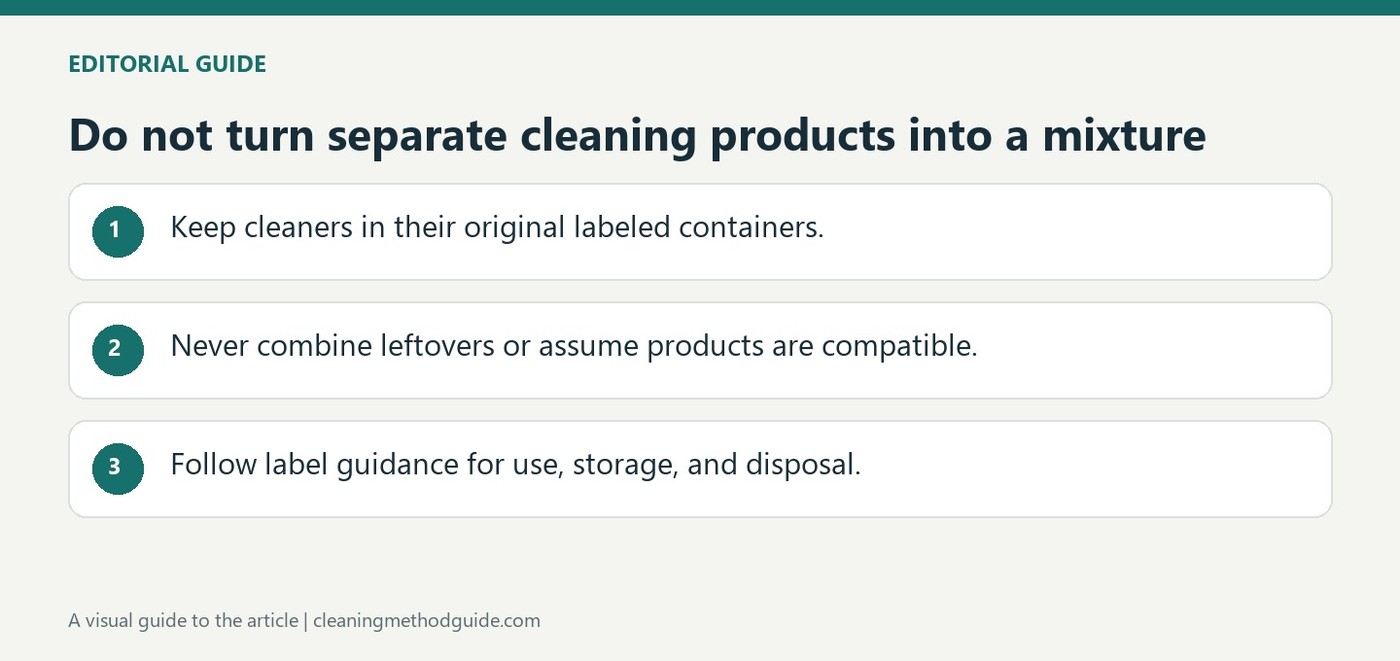
Ingredient conflicts can be serious
Homes and Gardens' cleaning-mixture guide warns that products useful on their own can become hazardous together. Bleach combinations are a particular concern, including reactions with ammonia and acidic products. The advice is to check ingredients and warnings instead of assuming two cleaners are compatible because both belong in the bathroom.
Use one supported method at a time
A stronger-looking mixture is not evidence of better performance. Follow the product's dilution, surface and rinsing instructions, and keep the bottle identifiable. If a method fails, do not add another formula directly on top in an attempt to rescue it. Choose a different supported approach only after the earlier product has been handled as directed and incompatible residues are no longer present.
Organize supplies to reduce accidental combinations
The Homes & Gardens guide connects product separation with storage as well as deliberate mixing. Incompatible bottles placed together can spill or be selected in succession without the user recognizing the risk. Keep original containers identifiable and organize according to the label's storage requirements, rather than grouping every bathroom product into one indistinguishable collection. A room-based color system can support organization, but it does not establish chemical compatibility.
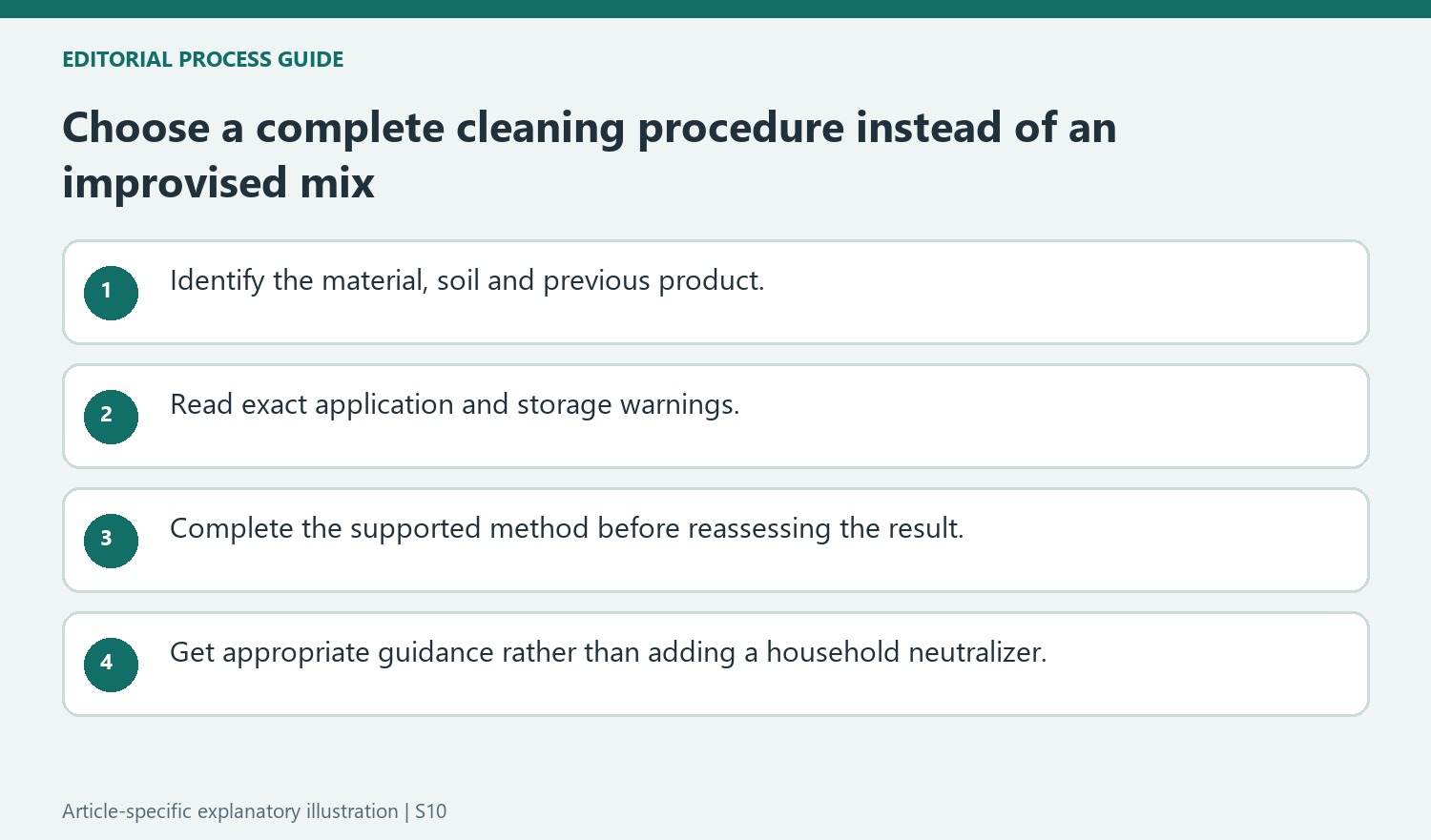
Check the cause of a poor result before changing formulas
The reference includes mixtures that create hazardous fumes and others that undermine cleaning performance. Those are different outcomes, yet both challenge the assumption that adding another ingredient must improve the result. For persistent marks, identify the material, the type of soil, and what has already been applied. Follow the earlier product's handling and rinsing directions before choosing another supported method. If a reaction or exposure has already occurred, leave the affected area and seek the appropriate emergency or poison-control advice. Do not remain nearby to test a household neutralizer. An eco-friendly or natural marketing claim does not remove the need to read these warnings.
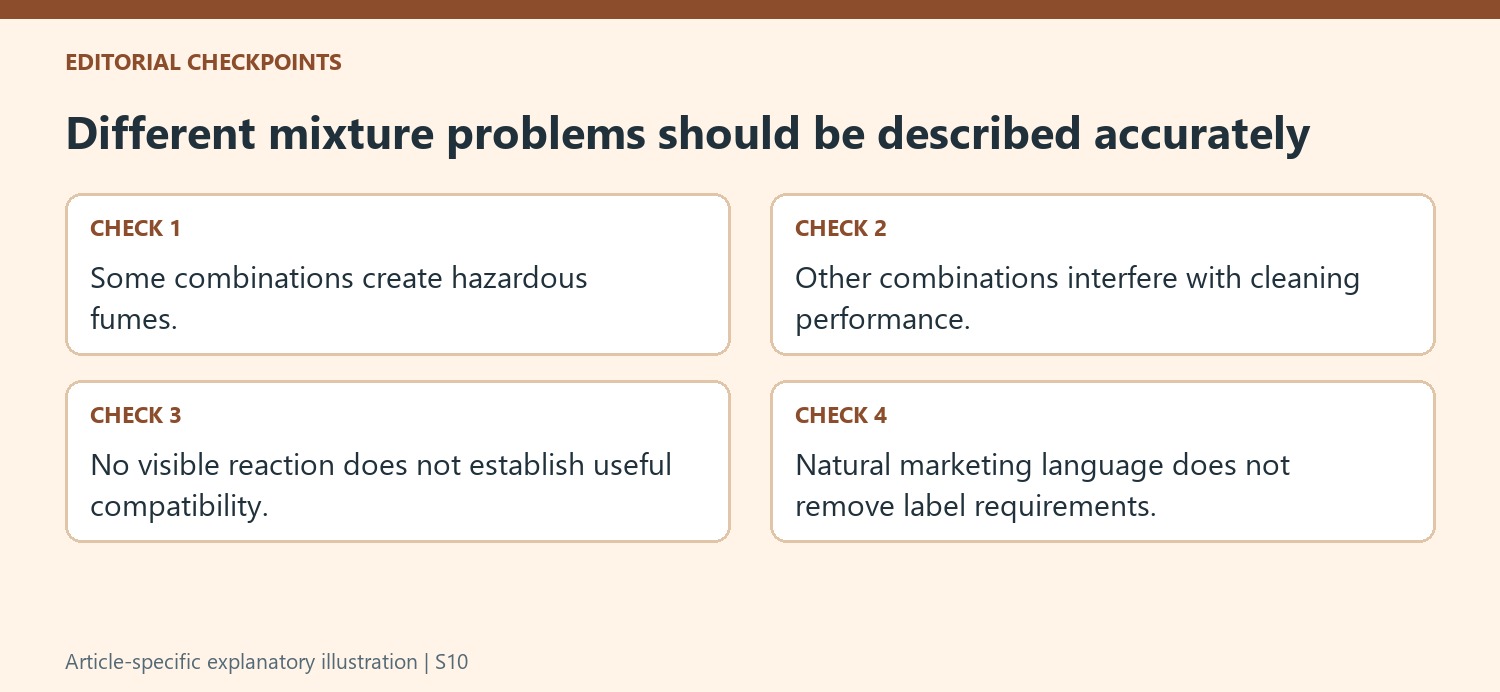
Distinguish hazardous reactions from ineffective mixtures
The feature discusses both toxic-fume risks and combinations that can undermine the cleaning result. Those are different reasons to reject the assumption that more ingredients must work better. A lack of visible fumes does not establish that an improvised mixture is useful, surface-compatible or permitted by either product's instructions.
The castile-soap and vinegar example concerns interfering with the intended cleaning action and leaving residue. That should not be described as the same event as an acid meeting chlorine bleach. Preserve the distinction while retaining the practical rule: select a supported procedure instead of treating every household ingredient as an acceptable addition to another formula.
Organize by the warnings as well as by convenience
Keeping supplies in a familiar place helps only when product identity and storage requirements remain clear. Read the labels before deciding which bottles can share a storage area, considering what could happen if a container leaks. A color-coded room system does not replace those ingredient and storage checks.
Maintain legible original information and avoid containers that could be confused with food or drinks. Other people using the same cupboard should be able to identify what has already been applied to a surface. Clear communication reduces the chance that a second person unknowingly follows one treatment with an incompatible cleaner.
Reassess a stubborn mark before selecting another approach
Identify the material, the soil and the product already used. Follow its handling and rinsing directions and consult the surface or product maker if the next step is uncertain. A natural or eco-friendly description does not establish compatibility, and a stronger smell or larger quantity does not demonstrate a better method.
If a reaction or exposure has already occurred, move away and seek appropriate emergency or poison-control advice rather than applying an improvised neutralizer. For routine cleaning, the more useful strategy is a controlled complete process that can be evaluated. One suitable product, an appropriate tool and the required time provide clearer information about the result than an undocumented mixture of several formulas.
References
- 5 cleaning products you should never mix – and why it can prove so dangerous. Homes and Gardens; Chiana Dickson.
Homes and Gardens' cleaning-mixture guide warns that products useful on their own can become hazardous together. Bleach combinations are a particular concern, including reactions with ammonia and acidic products. The advice is to check ingredients and warnings instead of assuming two cleaners are compatible because both belong in the bathroom.


Leave a Comment
Comments (0)