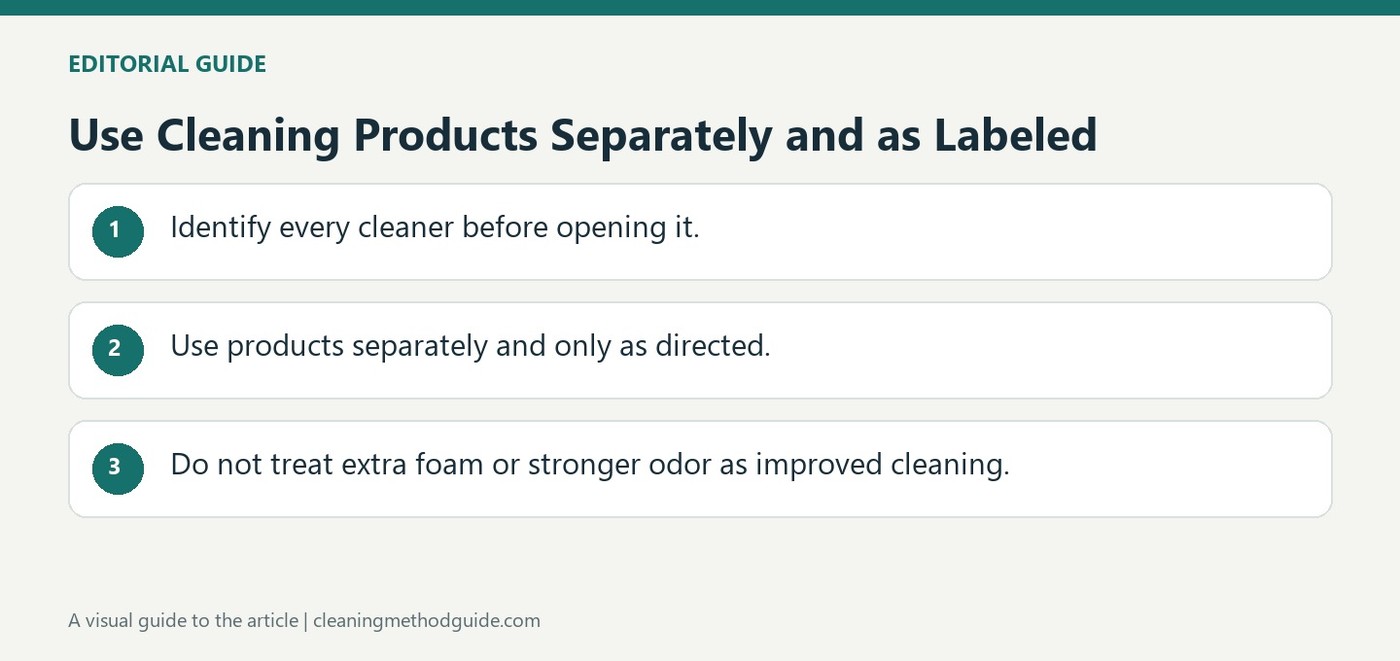
Cleaning products are formulated for particular tasks and should not be blended to make an imagined stronger solution. Mixing bleach with ammonia or acidic cleaners can release dangerous gases. A social media recipe is not a substitute for the manufacturer's directions.
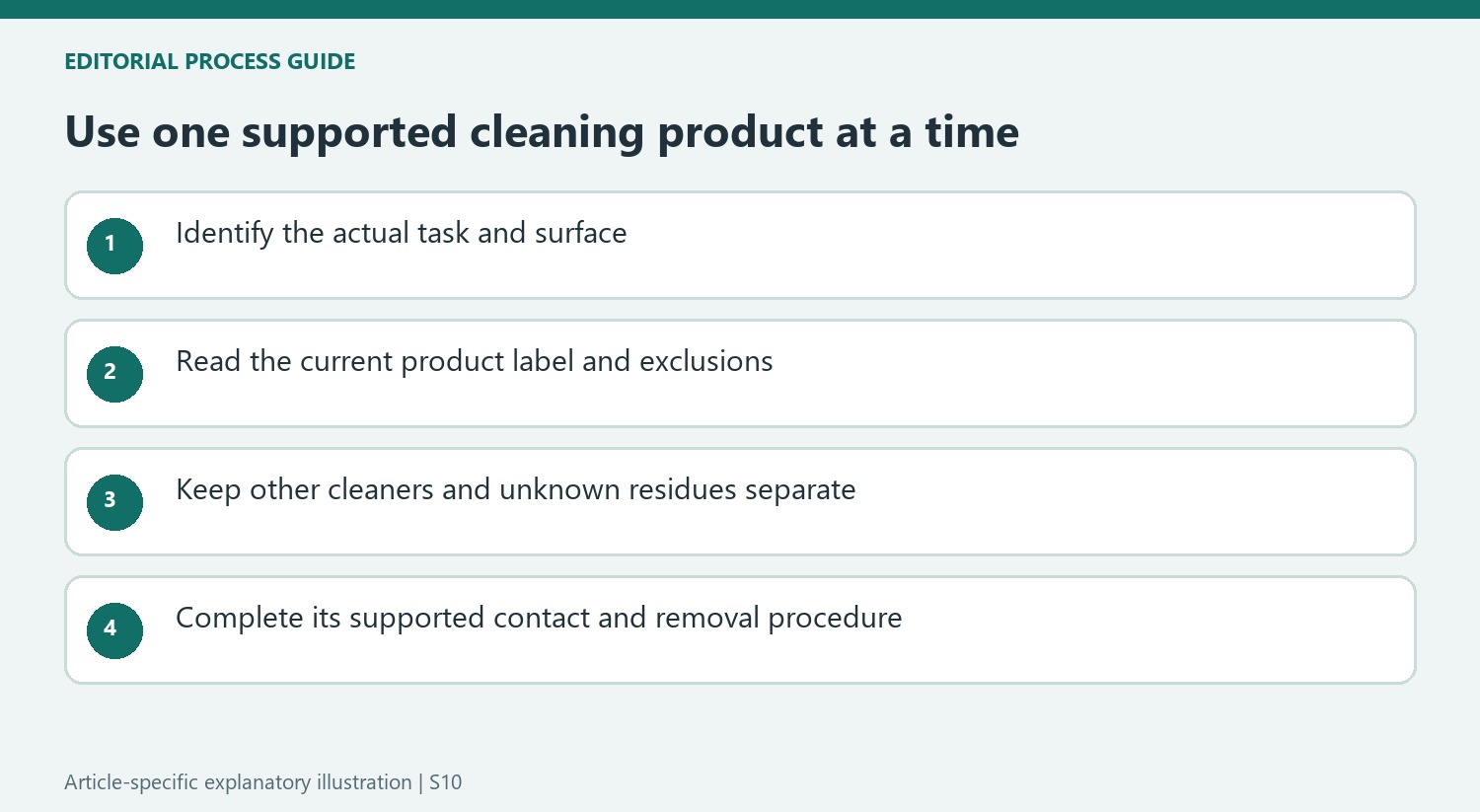
Read each label, use the specified dilution and ventilation, and do not add another product unless the manufacturer explicitly directs it. Keep products in their original containers. If unexpected fumes develop, leave the area and seek appropriate emergency or poison-control advice rather than continuing to clean.
Keep the original product task in view
Neil Spencer-Cook of the British Institute of Cleaning Science distinguishes jobs such as descaling, disinfection, and dirt removal. Products designed for those different purposes have their own formulations and directions; bringing them together does not create a supported all-purpose improvement. Select the appropriate task and surface first, then read the exact container. A short video rarely establishes the ingredients, residues, or ventilation conditions in another person's bathroom.
Reassess an ineffective method without layering formulas
The Ideal Home feature specifically warns about adding bleach after another toilet treatment. A dirty-looking bowl is not a reason to ignore incompatibility warnings. Follow the earlier product's instructions, retain its identity, and seek suitable guidance if the next step is uncertain. Do not use a second cleaner as an improvised neutralizer. If unexpected fumes or a reaction develop, move away and contact the appropriate local emergency or poison-control service as necessary. The article's broad lesson is restraint: safe, effective cleaning depends on a documented method and appropriate amount, not a larger mixture or the popularity of an online demonstration.
Treat different product purposes as a reason for separation
Ideal Home quotes the British Institute of Cleaning Science on products being formulated for particular tasks such as descaling, soil removal and disinfection. Those distinct purposes do not mean that combining the bottles creates a more complete cleaner. Read the current labels and use each only through its supported procedure. A social-media demonstration with impressive foam is not a reliable guide to compatibility or evidence that the resulting mixture cleans better.
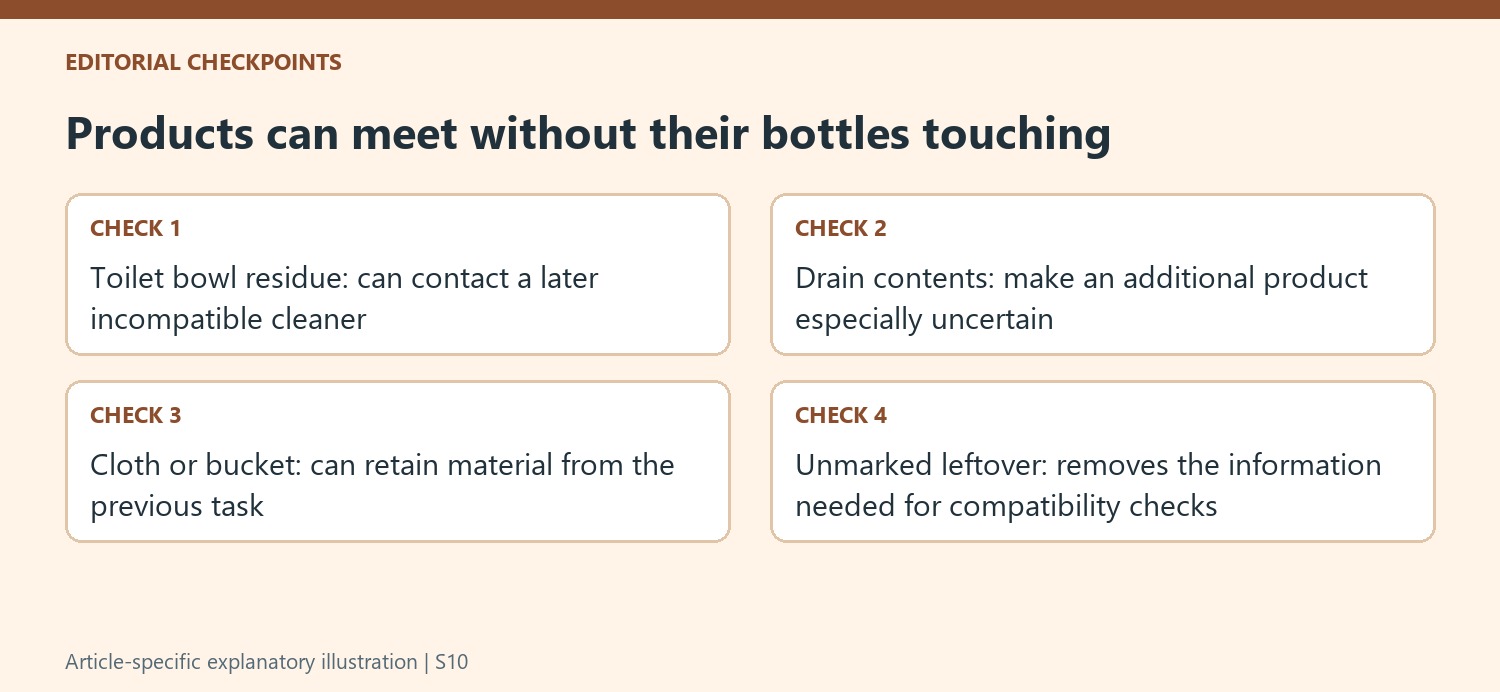
The article's prohibition covers layering as well as mixing in a separate container. A second product can contact residue left in a toilet, drain, cloth or bucket even if the bottles never touch. Do not add another cleaner merely because the first seems ineffective or its fragrance has faded. Complete only the supported procedure and follow its directions before any separate next task, seeking product-specific advice where the previous chemical exposure is unknown.
Use the named examples without inventing precise reaction claims
The source lists familiar hazardous pairings including bleach with ammonia or acids, and it cautions against combining drain products. Keep those examples as clear reasons to avoid the combinations rather than a menu for experimenting. Formulations vary, so a broad ingredient name or a product marketed as natural does not establish that it is compatible with the contents of another bottle. An acidic pantry ingredient remains relevant to those restrictions.
Some explanations in general household articles simplify the chemistry, but the practical instruction does not depend on predicting exactly which reaction will occur in a particular container. Never mix bleach with vinegar or ammonia-containing cleaners, and do not combine different drain cleaners. Follow the full current label rather than assuming an unlisted combination is approved. A pair absent from a short article's examples has not therefore been tested or recommended for joint use.
Let unexpected exposure end the task rather than trigger another mixture
If an unapproved combination produces fumes or irritation, move away and follow appropriate exposure guidance instead of adding another chemical to cancel it. Seek local emergency or poison advice when needed and retain product identities for that advice without re-entering an affected area unnecessarily. Ventilation is part of normal labeled cleaning, but it is not permission to stay beside an unknown reaction or continue scrubbing until a scheduled job is finished.
For ordinary work, keep bottles identified and closed, select one supported product and handle cloths or containers in accordance with their previous use and washing instructions. Do not consolidate leftover cleaners to save shelf space. The source's central point is that a stronger-looking combination is not a useful upgrade to a formulated product. Separate labeled use preserves the information needed to choose the correct surface, dose, contact and removal stages for the task actually being performed.
References
- The one thing you should never do with your cleaning products – no matter what. Ideal Home; Lizzie Thomson; Jullia Joson.
Cleaning products are formulated for particular tasks and should not be blended to make an imagined stronger solution. Mixing bleach with ammonia or acidic cleaners can release dangerous gases. A social media recipe is not a substitute for the manufacturer's directions.


Leave a Comment
Comments (0)