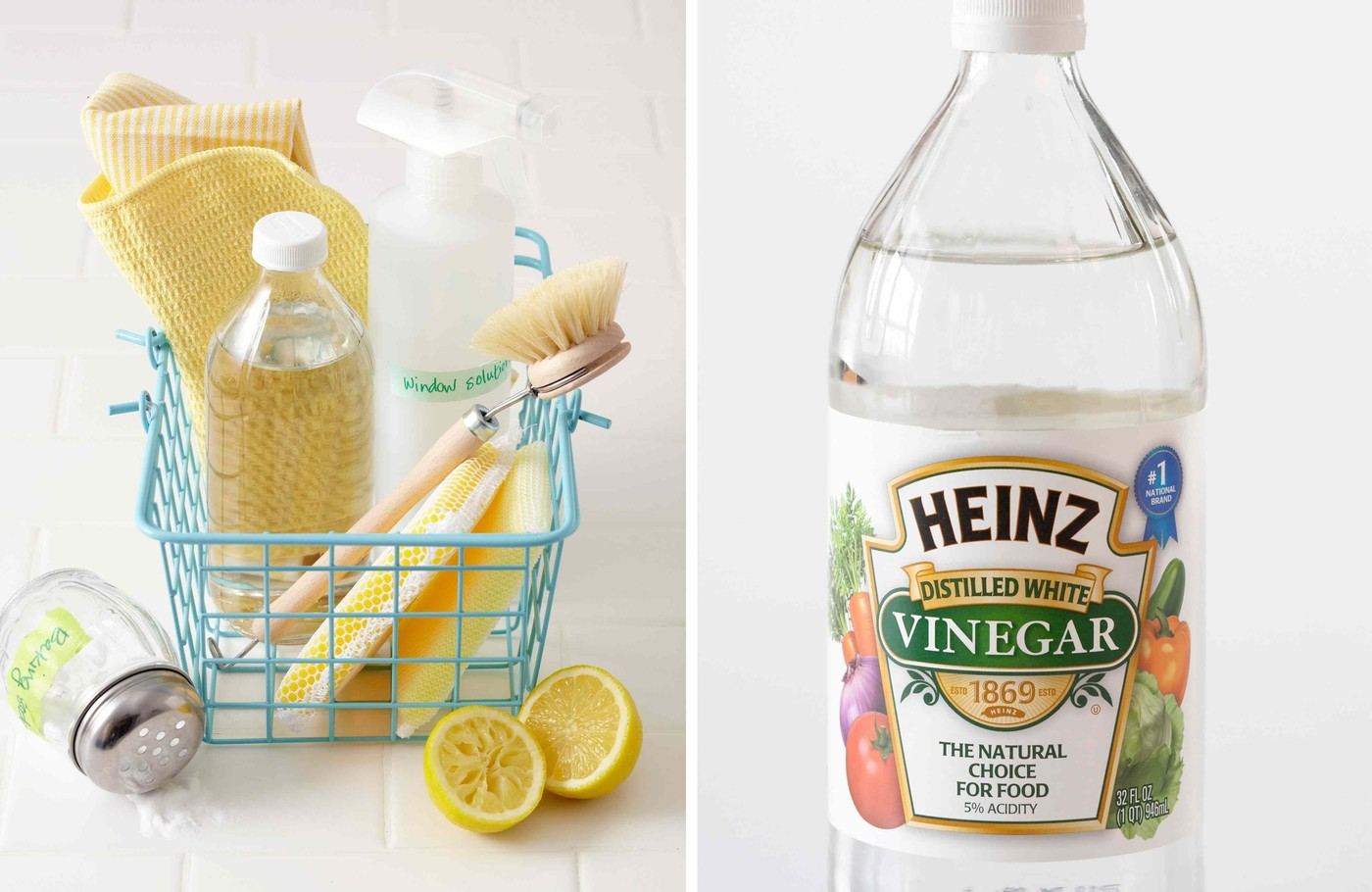
Concentration and intended use matter
Better Homes and Gardens distinguishes food-grade white vinegar from stronger cleaning vinegar. The latter is not intended for consumption, even though both products are acidic. The guide identifies precautions such as gloves, ventilation and suitable storage, so a familiar ingredient name should not be taken as proof that no handling instructions are needed.
Check the surface before applying it
The article warns against using vinegar on several vulnerable materials, including natural stone and electronics. Keep it separate from bleach and follow the product directions. Acidity that helps with some deposits can also damage a finish, making surface identification and a limited compatibility check more useful than applying the same homemade routine throughout the home.
Read the actual concentration and intended use
The comparison uses typical examples of five-percent food-grade white vinegar and six-percent cleaning vinegar, but the article also notes that stronger cleaning products exist. Read the container instead of assuming every bottle follows those examples. Cleaning vinegar is not intended for food or consumption, so store it where it cannot be mistaken for a cooking ingredient. Its familiar name does not remove the need for ventilation, protection, and clear identification.
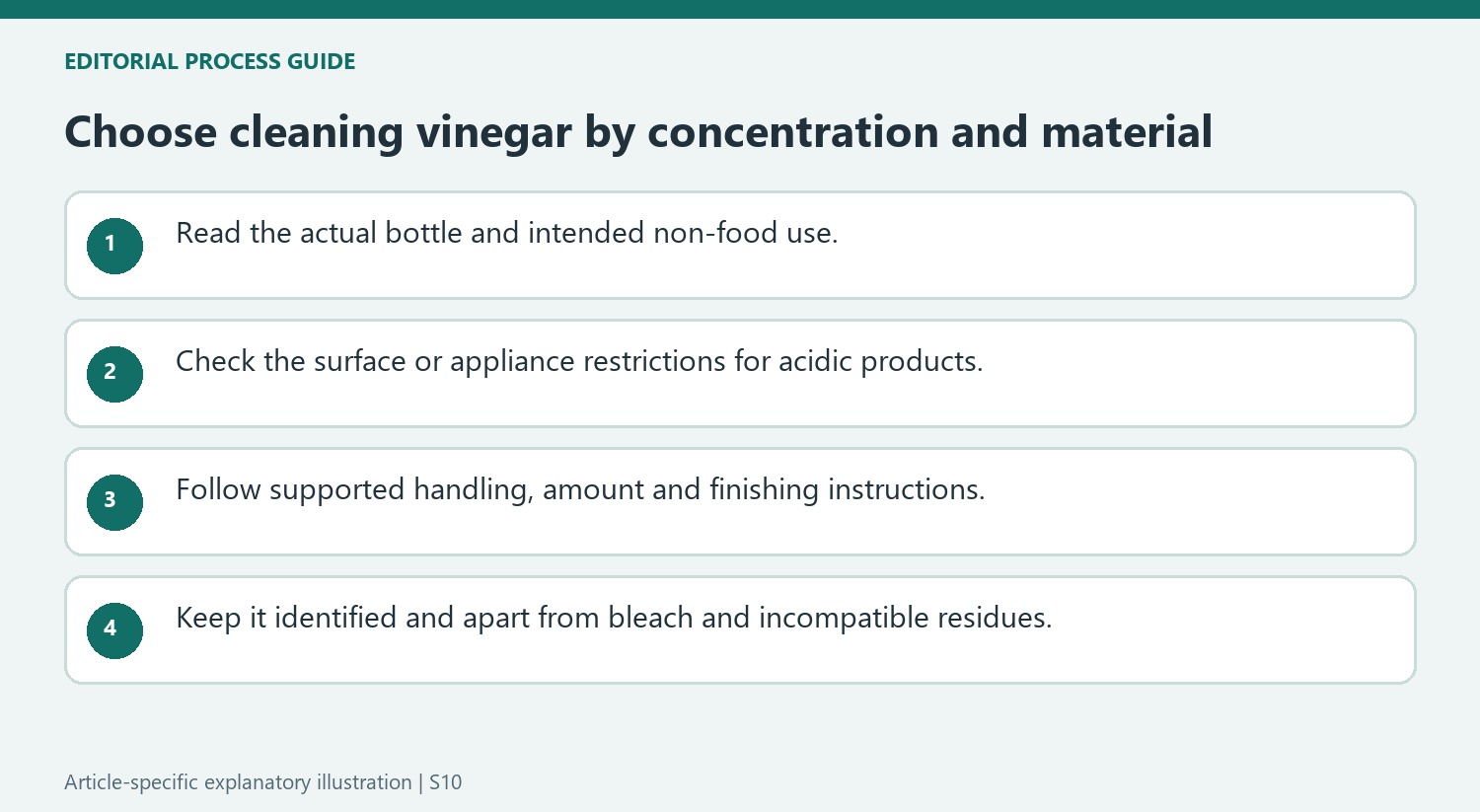
Treat acidity as both a useful property and a restriction
An acid can help with some mineral deposits while damaging another surface or component. The guide lists vulnerable materials including natural stone, certain wood finishes, electronics, and rubber parts. Consult the actual surface or appliance instructions before use rather than treating a hidden patch test as permission for an otherwise prohibited treatment. Keep vinegar away from bleach and other incompatible products. Its cleaning role also should not be generalized into a claim that it performs a registered disinfection task. Choose a method for the specific soil and material, use the labeled amount, and finish with any required rinsing or drying.
Use the container to resolve concentration and intended purpose
The article compares typical food-grade and cleaning-vinegar concentrations while acknowledging that stronger versions exist. Read the actual bottle rather than treating those examples as a universal specification. The word vinegar alone does not identify the concentration, permitted application or food-use status of every product carrying it.
Cleaning vinegar should remain clearly distinguished from a cooking ingredient. Keep the label and suitable storage so another person does not mistake it for food-grade vinegar. Do not transfer it into a beverage or food container. A familiar ingredient name can otherwise obscure the practical difference the source is trying to explain.
Match an acidic cleaner to both soil and material
Acidity may be useful for some deposits, but the same property can be unsuitable for another finish or component. The guide lists vulnerable surfaces and appliance parts. Consult the actual manufacturer's care instructions before using it, especially where stone, coatings, rubber or electrical equipment are involved.
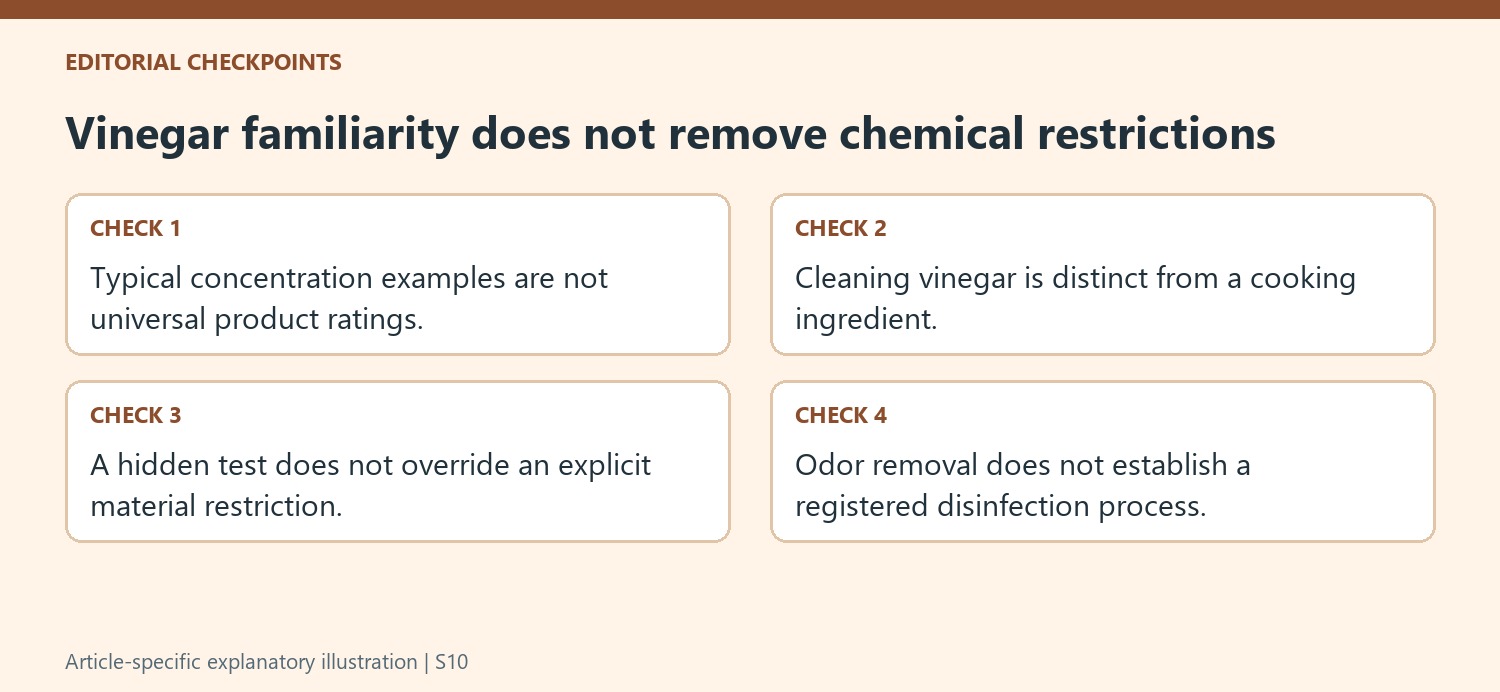
A small hidden test does not override an explicit instruction against acidic treatment. Likewise, a stronger concentration should not be assumed to improve every task or justify reducing an amount by guesswork. Select a supported method for the specific soil and surface, then follow the product's handling and finishing instructions rather than applying one homemade routine throughout the home.
Separate cleaning usefulness from disinfecting claims
The feature discusses odors and cleaning performance, but those descriptions should not become a universal claim that vinegar performs a registered disinfecting procedure. When a task specifically requires sanitizing or disinfection, choose appropriate guidance and a product supported for that purpose instead of relying on a fresh smell.
Keep vinegar apart from chlorine bleach and other incompatible products, including residues from earlier treatments. Ventilation and recommended protection support correct use without changing that incompatibility. Store the identified product appropriately after finishing and leave the area suitably rinsed or dried when required. The practical lesson is to treat cleaning vinegar as an acidic cleaning chemical with useful applications and real restrictions, making the exact label and material guidance more important than its familiar household name.
References
- Cleaning Vinegar vs. White Vinegar—When to Use Each One. Better Homes & Gardens; Jolie Kerr.
Better Homes and Gardens distinguishes food-grade white vinegar from stronger cleaning vinegar. The latter is not intended for consumption, even though both products are acidic. The guide identifies precautions such as gloves, ventilation and suitable storage, so a familiar ingredient name should not be taken as proof that no handling instructions are needed.


Leave a Comment
Comments (0)