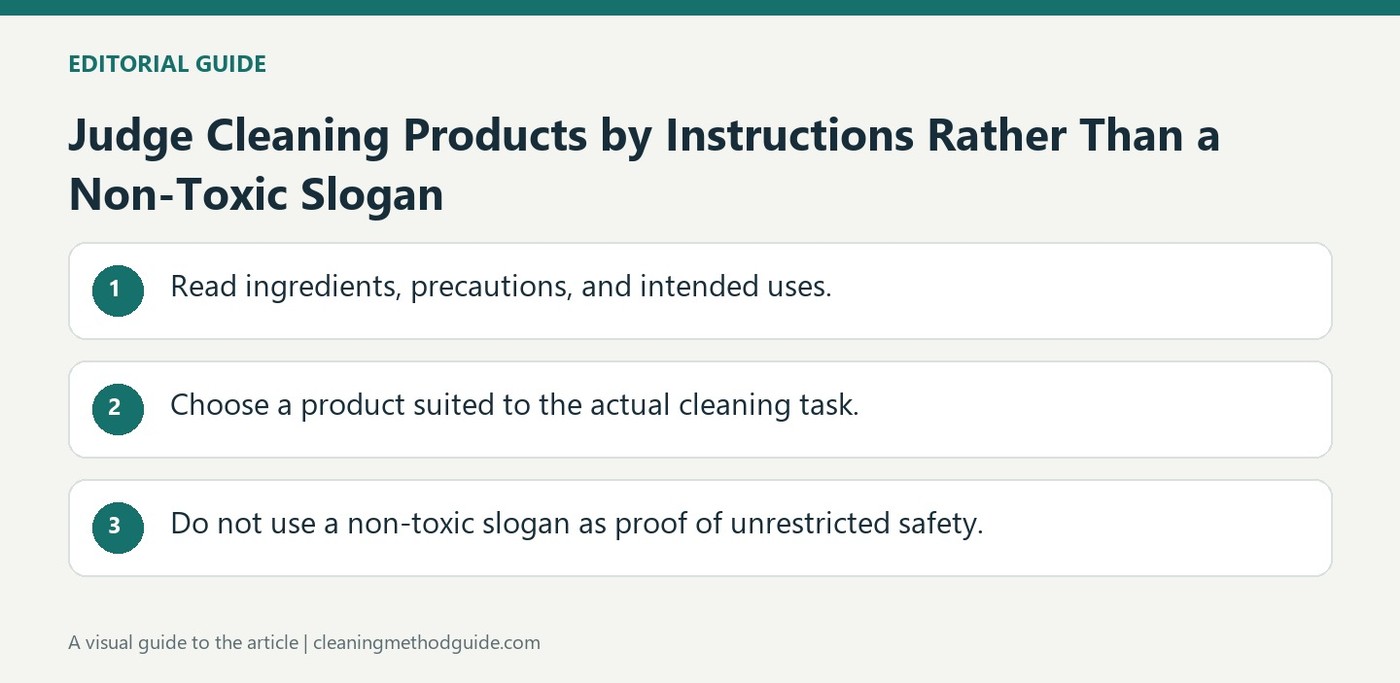
Homes & Gardens' cleaning-product guide explores ingredients, environmental claims and product selection. Its wider message is to look beyond attractive packaging when choosing supplies for a home with different surfaces, people and pets.
Read hazard statements, dilution requirements and compatibility directions even on products described as natural. Do not assume essential oils or pantry ingredients are harmless substitutes for every task. Choose a cleaner that fits the job, use the specified protection and ventilation, and distinguish ordinary cleaning from any separately labeled disinfecting claim.
Compare the claim with the job and product instructions
The feature discusses plant-based ingredients, packaging, certifications, and homemade options. Those are different properties and should not be collapsed into a single promise that a product is harmless or suitable everywhere. Read the actual hazard and use information alongside environmental claims. An acidic ingredient can damage a vulnerable surface, an abrasive powder can mark a finish, and fragrance or essential oil can introduce its own exposure concerns.
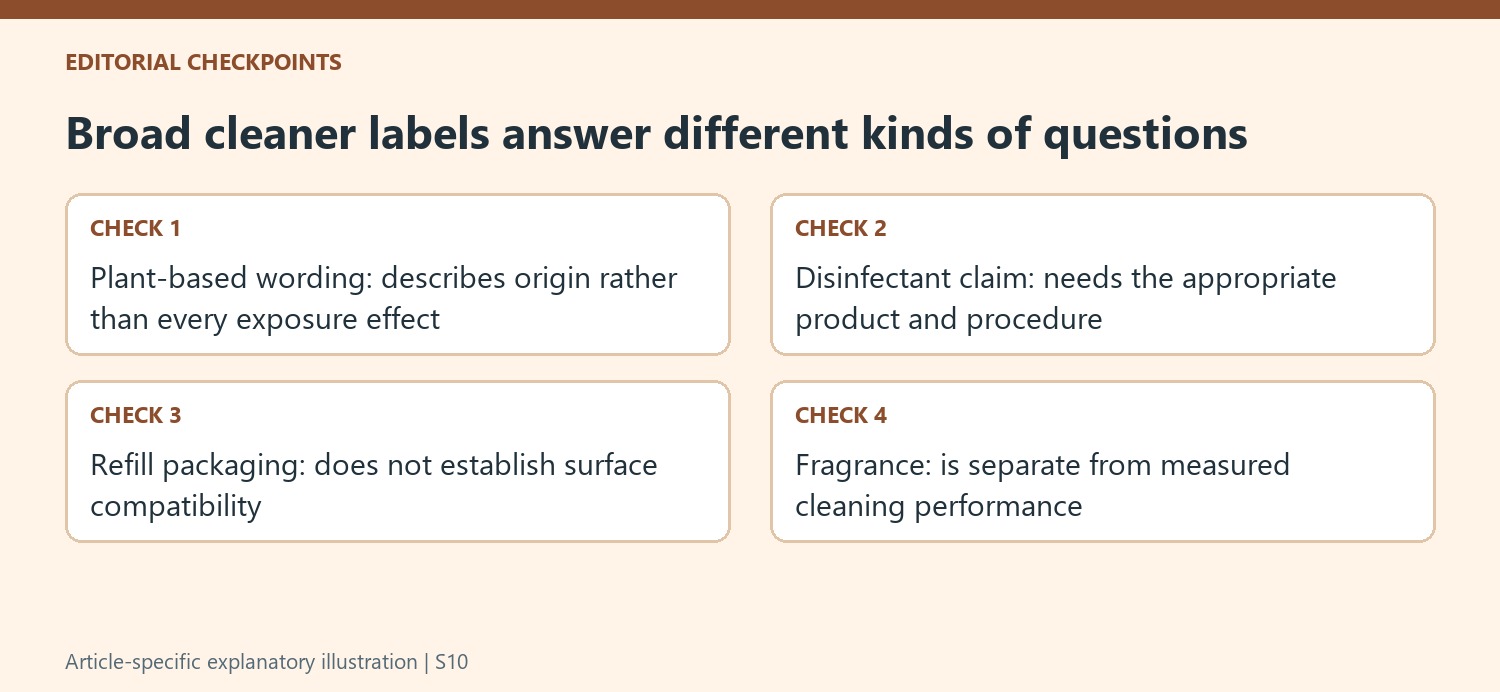
Separate ordinary cleaning from a disinfection requirement
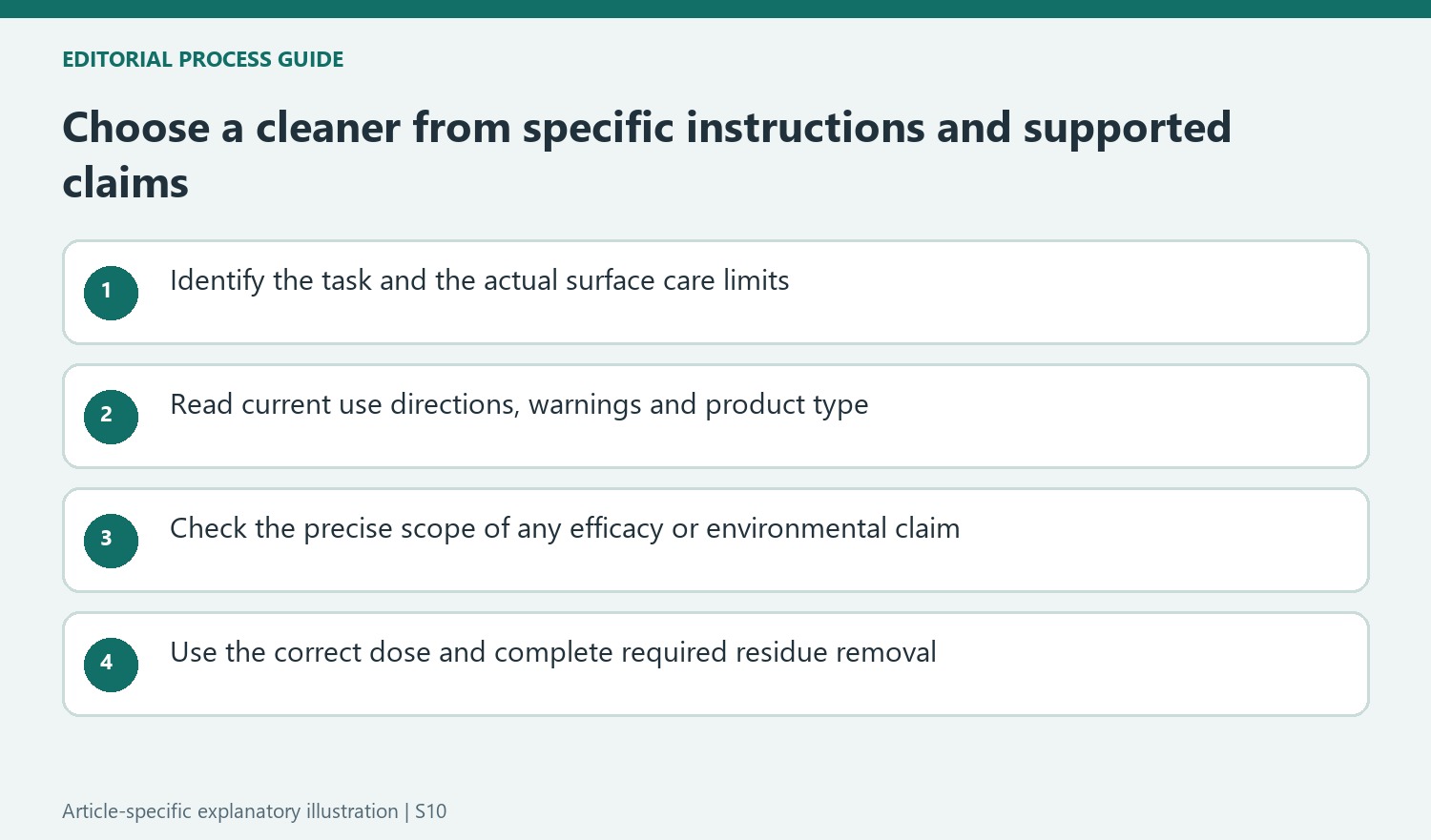
A useful selection process begins with the surface and soil, then checks the supported amount, application method, protection, and rinsing or drying. If a task specifically needs disinfection, use the relevant public-health and registered-product guidance rather than inferring that a pantry ingredient has the same tested claim. Do not add oils or other cleaners to a commercial formulation merely to improve its smell. The source's personal experiences and shopping suggestions can inform comparisons, but they do not replace a product label or the item's care instructions. A smaller kit of appropriate, clearly identified supplies can be easier to use correctly than an assortment bought for reassuring slogans.
Read the intended use before the broad marketing description
Homes & Gardens surveys products sold with natural, plant-based or non-toxic language. Those descriptions can express a brand's positioning without establishing the actual formulation's suitability for a task. Read the current use instructions, warnings and permitted surfaces before selecting it. A product designed for ordinary grease removal is not automatically a disinfectant, and a cleaner suitable for one kitchen finish may still be excluded from another material nearby.
The source includes contributors affiliated with cleaning brands, so keep their product praise attributed rather than treating it as an independent universal safety finding. Ingredient origin alone does not determine the effect of concentration, exposure or intended use. Plant-derived fragrance can still be an unnecessary addition for a sensitive household, while a chemical-sounding ingredient name alone does not establish that the labeled product is unsuitable. Evaluate specific directions and credible evidence for the actual claim.
Keep familiar household ingredients inside their chemical limits
The guide offers vinegar, lemon juice, baking soda, soap and essential-oil suggestions. Familiarity with those materials does not remove their acidity, abrasiveness or other compatibility questions. Do not apply an acidic recipe to a surface whose care instructions exclude it, and do not mix an ingredient into a prepared cleaner without explicit manufacturer approval. A visible fizz is not a validated measure of soil removal, disinfection or the absence of residue afterward.
Hand dish soap and dishwasher detergent also serve different systems. Do not substitute a foaming soap for a dishwasher product merely because a broad lifestyle suggestion calls it versatile. Follow the appliance's approved product type and dosage. Likewise, a peroxide-containing product or an essential-oil mixture is not automatically suitable for every food-contact surface, toy, pet area or textile simply because the source describes it with reassuring household language.
Separate packaging preferences from cleaning performance claims
The article discusses refill packs, concentrated products and recycled packaging as purchasing considerations. Those features concern materials and storage or transport decisions; they do not prove disinfectant efficacy or surface compatibility. Prepare a concentrate only through its actual label, using the correct container and dilution. Never combine leftovers or change the concentration because a smaller bottle seems convenient, and retain identification when a manufacturer-approved refill system is used.
Where a certification or environmental claim matters, check its current scope rather than turning a shopping badge into a blanket statement that a product contains no chemicals or cannot cause irritation. Complete the actual cleaning procedure, including any required rinse and drying, before judging the result. A practical selection process compares intended task, surface permission, directions and supported claims, then considers packaging and fragrance preferences within those limits instead of treating one broad non-toxic slogan as the whole decision.
References
- The ultimate guide to non-toxic cleaning products – what to make, shop, use, and avoid at home. Homes and Gardens; Chiana Dickson; Ottilie Blackhall.
- When and How to Clean and Disinfect Your Home. Water, Sanitation, and Environmentally Related Hygiene (WASH).
Homes & Gardens' cleaning-product guide explores ingredients, environmental claims and product selection. Its wider message is to look beyond attractive packaging when choosing supplies for a home with different surfaces, people and pets.


Leave a Comment
Comments (0)