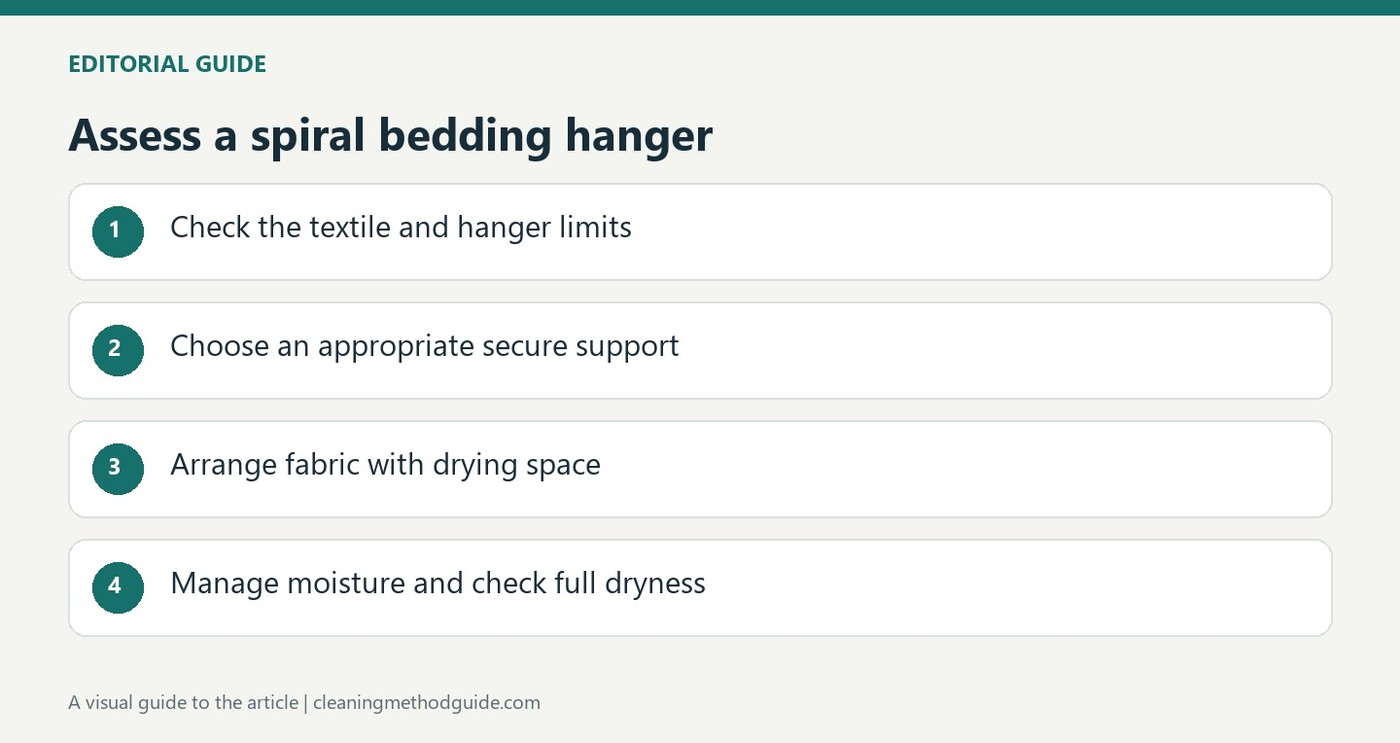
Ideal Home describes a spiral sheet hanger demonstrated by Stacey Solomon for drying a king-size duvet cover. The accessory lets a large fabric hang in a smaller footprint than a fully spread sheet. The article presents it as a possible aid for homes where bedding otherwise occupies a door frame or much of an airer.
It is a report of the gadget's use, rather than a controlled comparison of drying speed. Check the hanger's load limit and use a secure, suitable support; wet bedding can be heavy. Keep the fabric arranged to permit airflow and confirm that it is dry throughout before storing. Saving floor space does not remove the need to manage indoor moisture.
Understand what the accessory changes
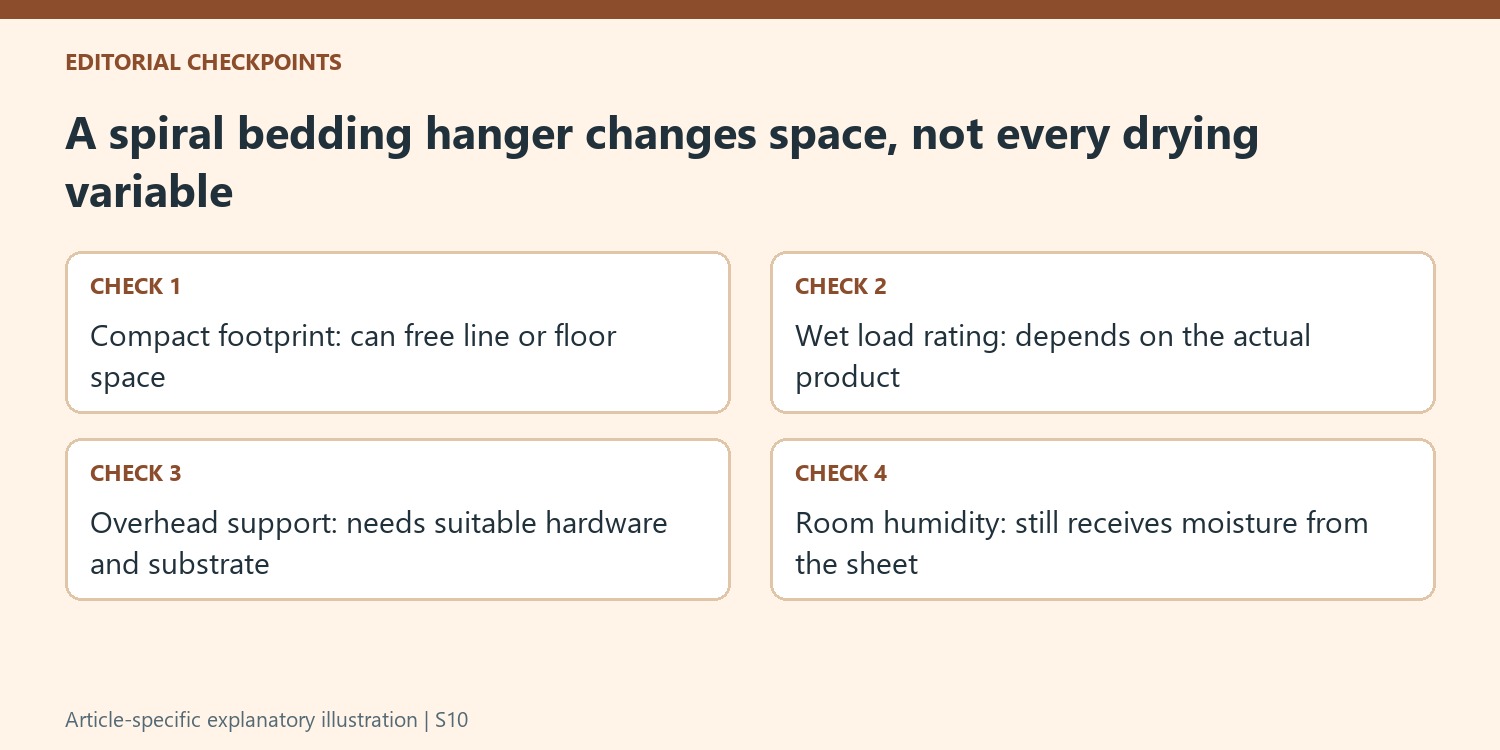
The reported benefit of the spiral hanger is how it arranges a large sheet or duvet cover in a compact hanging area. That is useful when one piece would otherwise occupy much of a room's drying support. It changes the footprint of hanging bedding, while the fabric still has to release its moisture into the surrounding air.
Plan the support before hanging wet bedding
Choose a location and support suitable for the loaded accessory, following the hanger and fixing instructions. The article discusses ceiling hooks and outdoor use, but a product mentioned in a shopping feature is not proof that any adhesive hook or ceiling can carry the same wet load. Check the installation rather than relying on the accessory's small empty size.
Retain the usual drying checks
Arrange the textile so it can dry rather than remain pressed into wet layers. The source warns that indoor laundry adds moisture to the home, so assess the room's ventilation or appropriate humidity control as well as its floor space. Inspect the whole cover before folding it away. A compact arrangement is worthwhile only if it also fits a complete, practical drying routine.
Separate the hanging footprint from the drying performance
Ideal Home describes a spiral sheet hanger featured in Stacey Solomon's household routine. Its main practical attraction is arranging a large sheet within a smaller hanging footprint. That is a space-management idea, not a controlled test showing that every duvet cover dries faster. The source reports enthusiasm and a demonstration rather than a measured comparison across fabric weights, room humidity and different hanging systems.
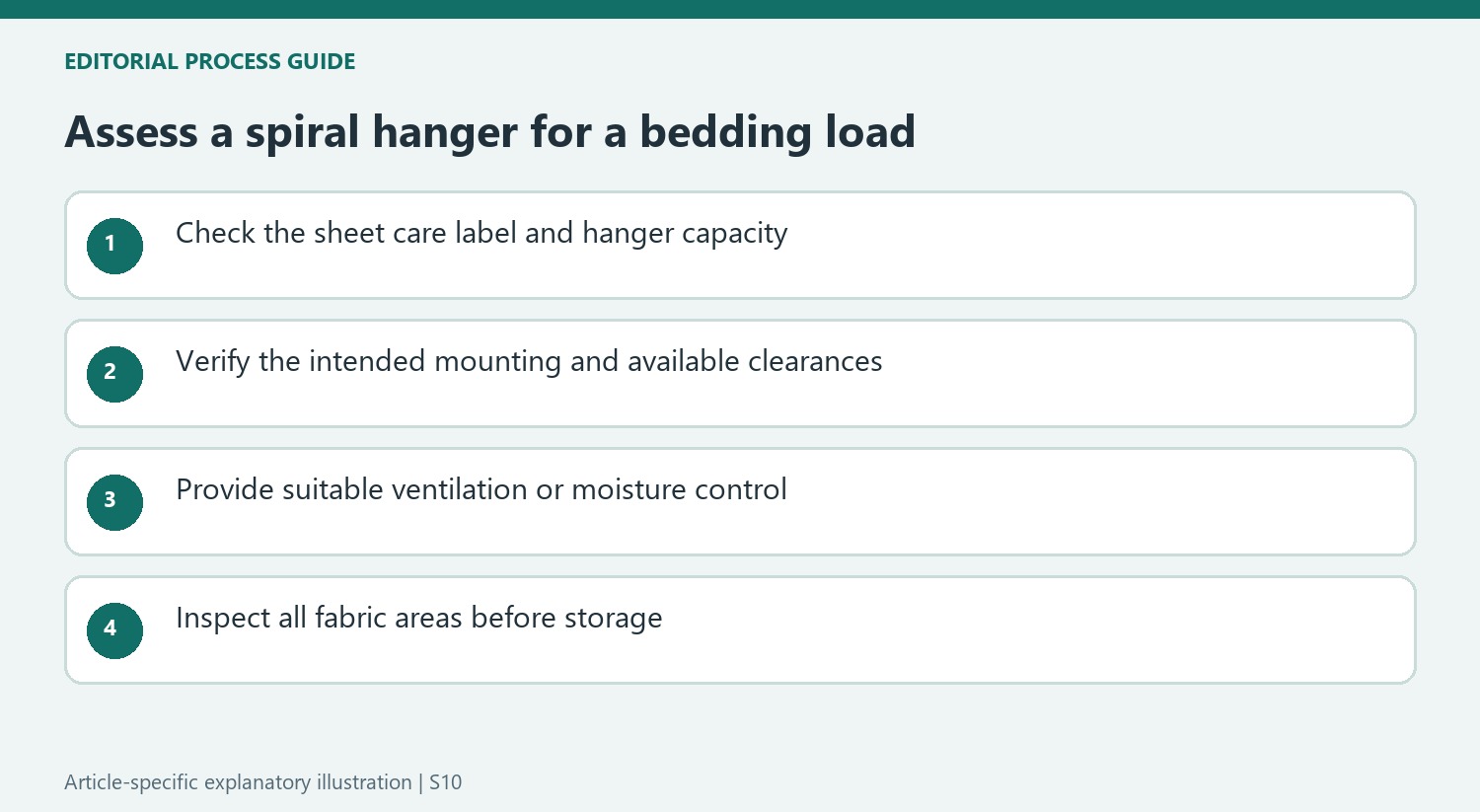
Check the actual hanger's dimensions, permitted load and intended use before choosing it for a particular bedding set. A compact support can still need vertical clearance and open space around the hanging fabric. A product listing or a celebrity example does not establish that a heavy wet blanket is acceptable on every similar spiral. Match the supported textile and attachment instead of treating the general shape as a universal load rating.
Make the overhead attachment a separate installation decision
The article discusses ceiling hooks and adhesive options, but those shopping suggestions do not establish the suitability of a specific ceiling, fixing or wet load. Follow the hardware's current instructions and any building or tenancy restrictions. The support needs to be appropriate for its surface and purpose, not merely convenient to install. Avoid inferring that an adhesive label described as heavy duty automatically settles an overhead laundry installation.
An outdoor line attachment also needs the hanger and line to support the proposed arrangement under their instructions. Consider clearance from surrounding objects and the practical effect of weather before hanging large wet bedding. The source's portability point can be useful, but moving the same accessory outdoors changes its exposure rather than removing the need for a compatible support. Installation, textile capacity and drying conditions remain three separate checks.
Keep room moisture control in the bedding plan
The guide explicitly warns that indoor drying adds moisture and can be problematic in an already damp home. A smaller floor footprint does not mean less water leaves the wet sheet. Provide suitable ventilation or properly used moisture-control equipment under its own instructions. Do not assume that a dehumidifier mentioned in the same article guarantees a dry room regardless of load size, placement or the actual building conditions.
Use the sheet's care label to choose the drying route and inspect folds and seams before putting it away. A pleasant freshly washed smell is not a measure of remaining moisture. The source's quoted price and product availability are also time-specific rather than a current purchase guarantee. Evaluate the hanger as one possible space arrangement within a complete drying system, with suitable mounting, textile clearance and full dry readiness all established independently.
References
- Stacey Solomon has shared the bargain buy she uses to dry bedding when it’s raining outside – no tumble dryer required!. Ideal Home; Lauren Bradbury.
The compact accessory wraps a large sheet around a spiral, but it still needs a suitable support and airflow.


Leave a Comment
Comments (0)