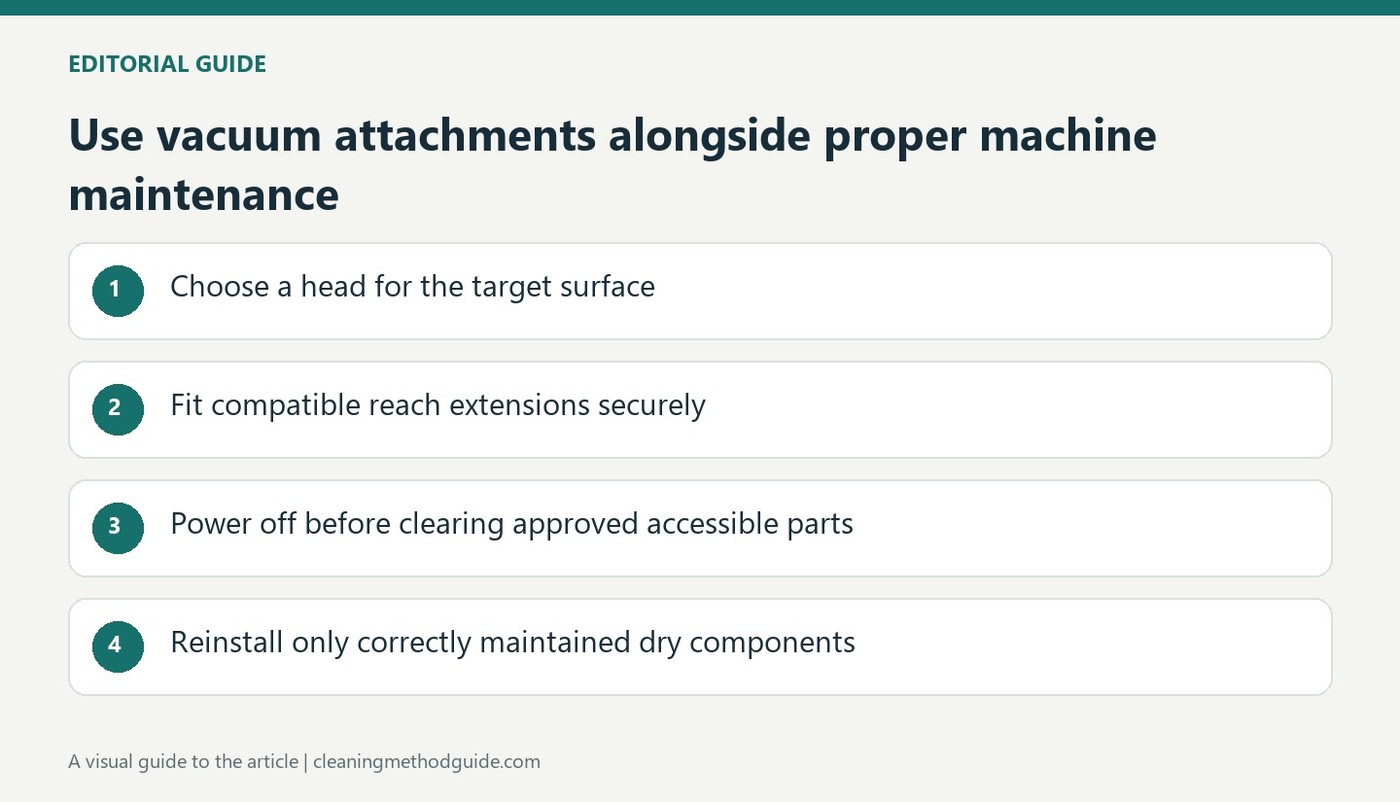
Homes & Gardens explains how common vacuum attachments serve different jobs. A crevice nozzle reaches narrow gaps, a soft dust brush addresses suitable above-floor surfaces and an upholstery tool is shaped for fabric areas such as cushions.
Check the surface's care instructions and choose appropriate suction instead of using the strongest setting everywhere. Keep delicate items supported and avoid hard nozzle edges on easily marked finishes. Familiarity with the included tools can improve routine cleaning without buying another attachment for every small task.
Match reach to the target area
Homes and Gardens distinguishes the narrow crevice head from the wider upholstery tool and the soft dust brush. An extension wand can bring a suitable head to a high frame or shelf without moving the main body into that space. Check that every connection is secure and compatible, and avoid using reach as a reason to lean on a fragile fitting.
Check maintenance when pickup falls
The guide links poor performance to an overfilled dust container, dirty filters, tangled brush rolls and blocked airways. Inspect those parts with the machine powered off, following the model's manual for access. Do not assume that the strongest suction setting or a newly purchased attachment will solve a maintenance problem elsewhere in the system. Keep nonwashable components away from improvised soaking.
Return only appropriately dry parts
The source separates washable filters from those needing replacement and emphasizes complete drying before reassembly. A part's appearance does not show whether it is washable. Follow its own instructions for water, detergent and drying time, and never reinstall damp filtration simply to finish the job sooner. Routine attachment care is useful only when the vacuum remains assembled in the condition its maker requires.
Learn the model before applying general maintenance advice
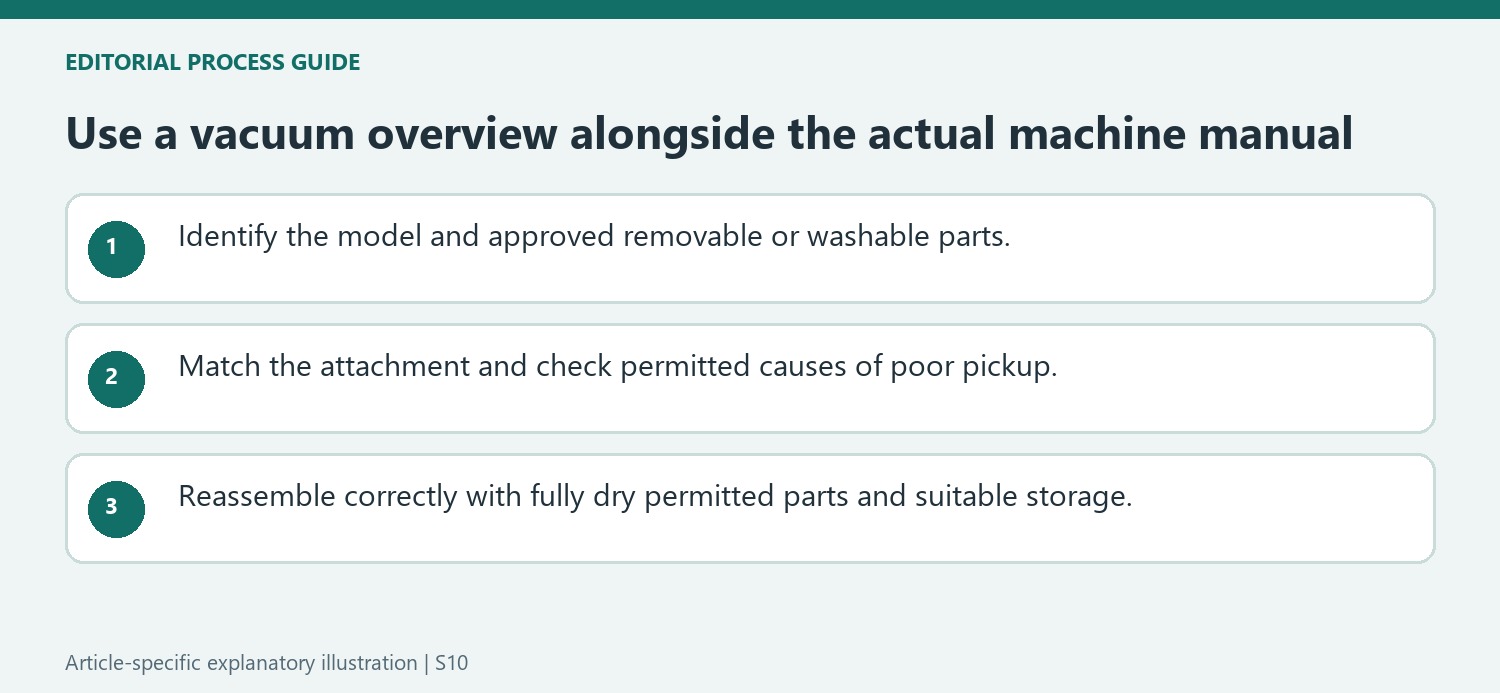
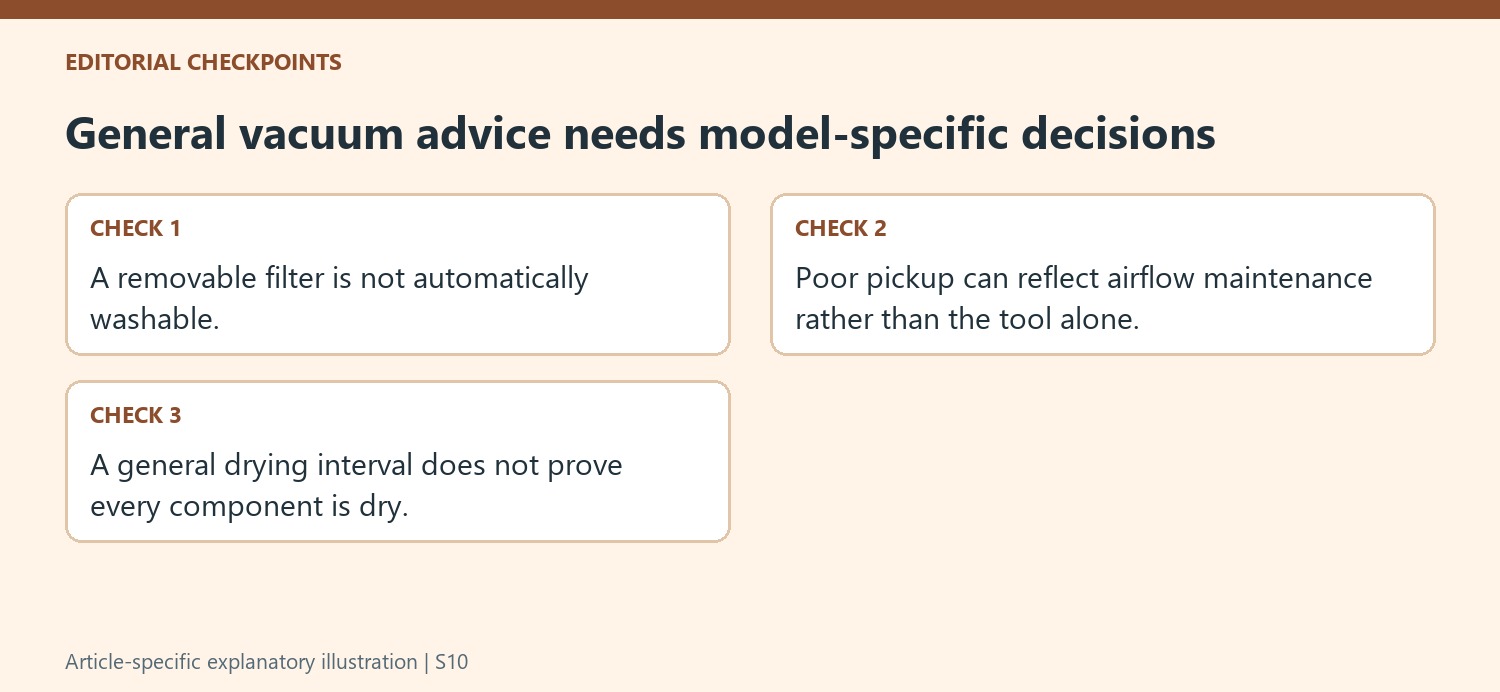
Homes and Gardens combines attachment descriptions with a broad vacuum-care routine. Begin by identifying the machine and obtaining its actual manual. Find the collection compartment, filters, head release, and any approved removable parts before dismantling anything. A general description of washing a bin or roller does not establish that the equivalent part on another machine tolerates water. Some filters need replacement rather than washing, and bags can have entirely different requirements. Disconnect power as directed before maintenance. Keep the model-specific method available beside the task so that a helpful overview does not become an improvised repair procedure.
Connect attachment choice with the cause of poor pickup
A crevice tool concentrates access in gaps while an upholstery head spreads suction over a smaller textile area. If pickup is disappointing, check the correct head and setting alongside the machine's permitted maintenance checks. An overfilled collection compartment, obstructed pathway, or dirty filter can affect performance independently of the accessory. Do not compensate by forcing the tool harder against a delicate surface. Follow the specified process for inspecting blockages rather than pushing sharp improvised objects into a hose. If unusual heat, a burning odor, or another fault appears, stop using the machine and follow its troubleshooting or service guidance instead of treating every smell as ordinary dirt.
Finish maintenance with a controlled return to service
Any part approved for washing must reach the dryness required by its instructions before reassembly. A fixed waiting interval in a general guide cannot confirm dryness in every room or material. Confirm filters and covers are seated and the airflow path is restored before operation. Store attachments together in a suitable clean, dry location so the right tool is easy to retrieve. A charging dock also needs the specified mounting, clearances, and power arrangement. The source includes broad cleaning schedules and powder suggestions, but these should not override a vacuum or floor maker's restrictions. The useful habit is to connect correct tool use, prompt emptying, and approved maintenance, preserving both the surface being cleaned and the appliance that collects the debris. Keep the manual and model details accessible for future maintenance.
References
- How to get the most from your vacuum cleaner – expert tips on use and maintenance. Homes and Gardens; Ottilie Blackhall; Dan Fauzi.
Crevice, dusting and upholstery tools make the appliance useful beyond open floors.


Leave a Comment
Comments (0)