
Distinguish the room resets from the deeper cleaning list
Better Homes and Gardens gives each room a small daily target: dishes and fresh mess in the kitchen, stray belongings in living spaces, and clothes or bedside clutter in the bedroom. The article explicitly leaves jobs such as wall washing or a full furniture dusting for another session. Its short routine is organized around restoring useful space rather than polishing every surface nightly.
Focus on dishes crumbs and clutter
Better Homes and Gardens suggests a brief daily routine instead of trying to deep clean the whole home every evening. The kitchen examples include dishes, counters, spills and stray items. The aim is to restore function and prevent small messes becoming larger tasks, while saving more time-consuming chores for another session.
Choose a time the household can repeat
The checklist can be completed at the end of the day or divided into shorter periods. Involve other household members where appropriate and target the areas that need attention that day. A timed routine is a way to limit the workload, not a guarantee that every home will be fully cleaned within the same number of minutes.
Keep each room's reset specific
The source's living-room examples include straightening cushions, folding throws and returning toys or games to storage. In the bedroom, it distinguishes putting clothes away from clearing the nightstand. These are visible, bounded actions that can be completed without opening a new deep-cleaning project. Select the ones that match how the rooms were used that day. A quiet room may need little attention while a meal, play session or busy kitchen creates a more immediate job elsewhere. Leave bigger tasks on the weekly or monthly list so the daily routine remains a repeatable reset rather than a growing inspection of every surface.
Choose trouble spots that actually recur in this home
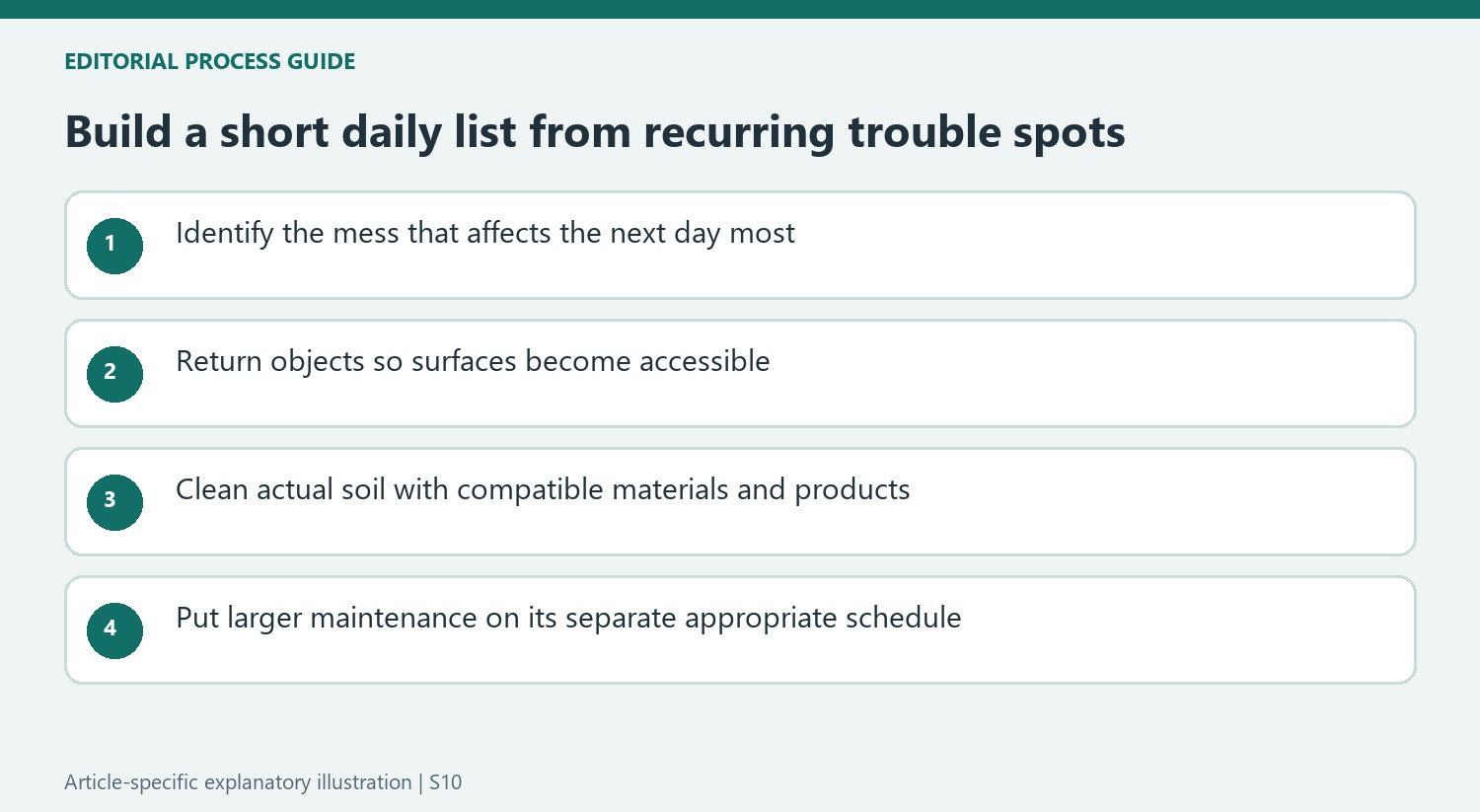
Better Homes & Gardens organizes its short daily checklist by the places where ordinary mess returns: dishes, countertop clutter, towels, sofa crumbs and clothing. Use that pattern to identify the few tasks that affect the next day most. A frequently used kitchen counter can deserve daily attention while a rarely occupied room does not need the same reset. The list is a planning tool, not a requirement to perform every possible room task regardless of condition.
Its suggested short total depends on the household and the amount of work present. Do not turn an example duration into a deadline that makes proper cleaning feel like failure when it takes longer. A fresh spill may need immediate appropriate treatment, while an unrelated larger task can stay on a weekly list. Keeping that distinction allows the daily routine to remain small without pretending that every hygiene or maintenance need fits inside a fixed number of minutes.
Clear objects before selecting compatible surface care
The source repeatedly separates returning objects to their places from wiping the surface beneath them. Put that order to work: remove dishes or toiletries so the cloth can reach the intended area without repeatedly shifting the same items. Tidying changes access and appearance, whereas cleaning removes soil. One does not prove the other is complete, and a clear counter should not be described as disinfected simply because it now looks orderly.
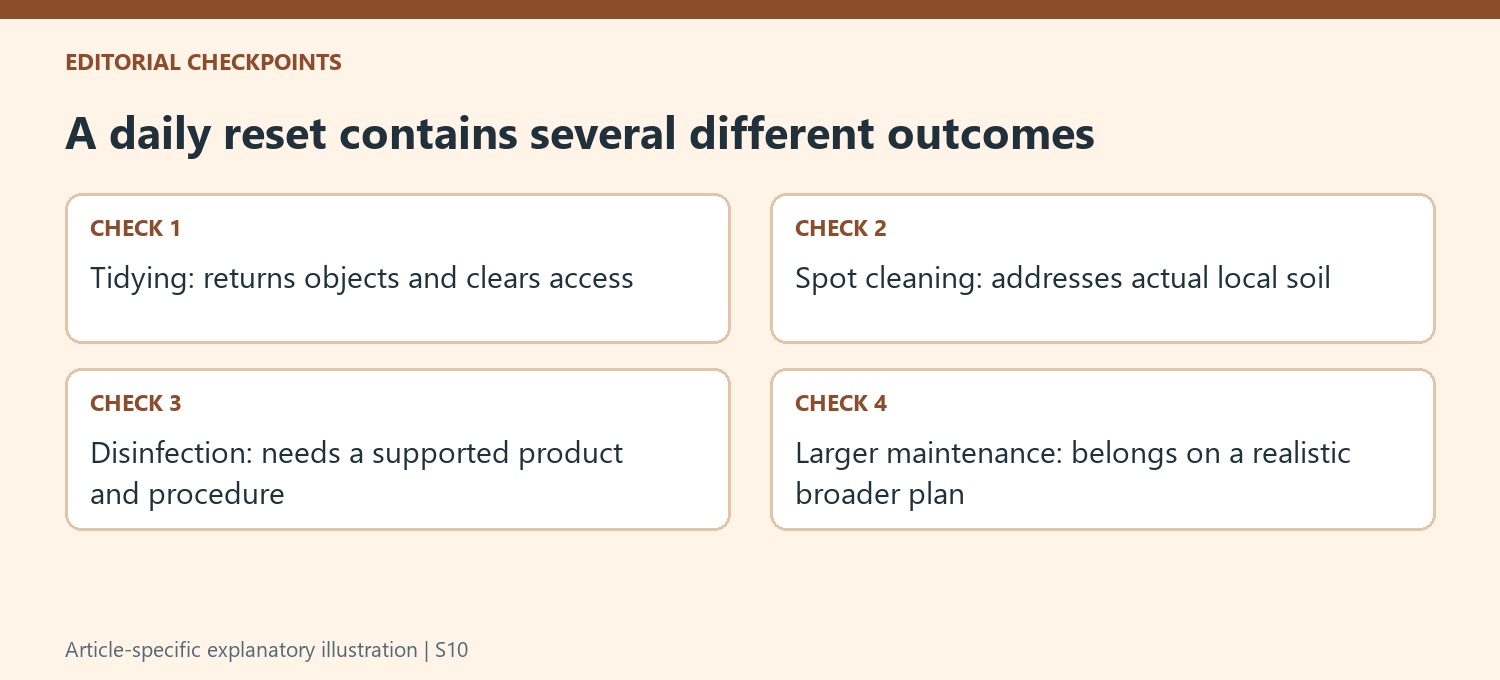
Choose products for the actual counter, mirror, fixture or flooring rather than treating a general all-purpose example as universal approval. Use clean appropriate cloths and keep bathroom handling separate from food-area cleaning. A short checklist is not a reason to move one dirty cloth through every room. Complete any label-required residue removal or contact stage even when the surrounding planning method encourages a quick pass.
Give routine resets and larger maintenance separate places
The article explicitly reserves deeper vacuuming, floor washing and other time-consuming work for a broader schedule. Keep those tasks visible elsewhere so a daily tidy does not become the only care a surface receives. Likewise, straightening sofa cushions is different from an upholstery-cleaning procedure. Use the daily inspection to notice a problem and route it to the right material-specific task instead of starting an unplanned intensive clean each evening.
The source allows work at the end of the day or in short intervals and suggests appropriate household participation. Choose a repeatable arrangement that matches actual responsibilities and capacity. Shared tasks should have clear ownership rather than leaving one person to discover what everyone else skipped. A useful daily list ends with accessible working surfaces, dealt-with immediate mess and a realistic next step for larger jobs, rather than a promise that the entire home can always be thoroughly cleaned in one brief session.
References
- This Daily Cleaning Checklist Gets the Job Done in 20 Minutes. Better Homes & Gardens; Jessica Bennett.
Better Homes and Gardens gives each room a small daily target: dishes and fresh mess in the kitchen, stray belongings in living spaces, and clothes or bedside clutter in the bedroom. The article explicitly leaves jobs such as wall washing or a full furniture dusting for another session. Its short routine is organized around restoring useful space rather than polishing every surface nightly.


Leave a Comment
Comments (0)